

What Unsplash Gets Wrong About Optimism
Happiness ≠ Optimism

First, A Few Updates
You Are Nature Reviews: If you’ve read my new book, thank you! And if you take a minute to review it where you bought it (Bookshop, Barnes & Noble, Amazon, etc.) double thank you!
“I found easy takeaways I can put in place without creating complicated goals or buying something new. I’m grateful for Adam’s enthusiastic yet gentle encouragement to find ourselves in nature.” — Lori Bailey
Coaching Openings: I have openings for 1:1 coaching. If you’re stuck, burned out, or navigating a transition—we will meet to explore what’s true, what’s possible, and how you move forward.
Indiana SHRM Conference: I’m going to be leading a session, “Grief at Work,” at the 2026 conference, held in Indianapolis this August 24-26. Let me know if you’re going to be there!
Summer and Fall Workshops + Speaking Events: I’m actively working to book workshops, podcasts, and talks for the next several months. Have a team? Know an organization? Able to make an introduction? Check out the topics and experiences available to help create meaningful growth.
Unsplash, we need to talk about optimism.
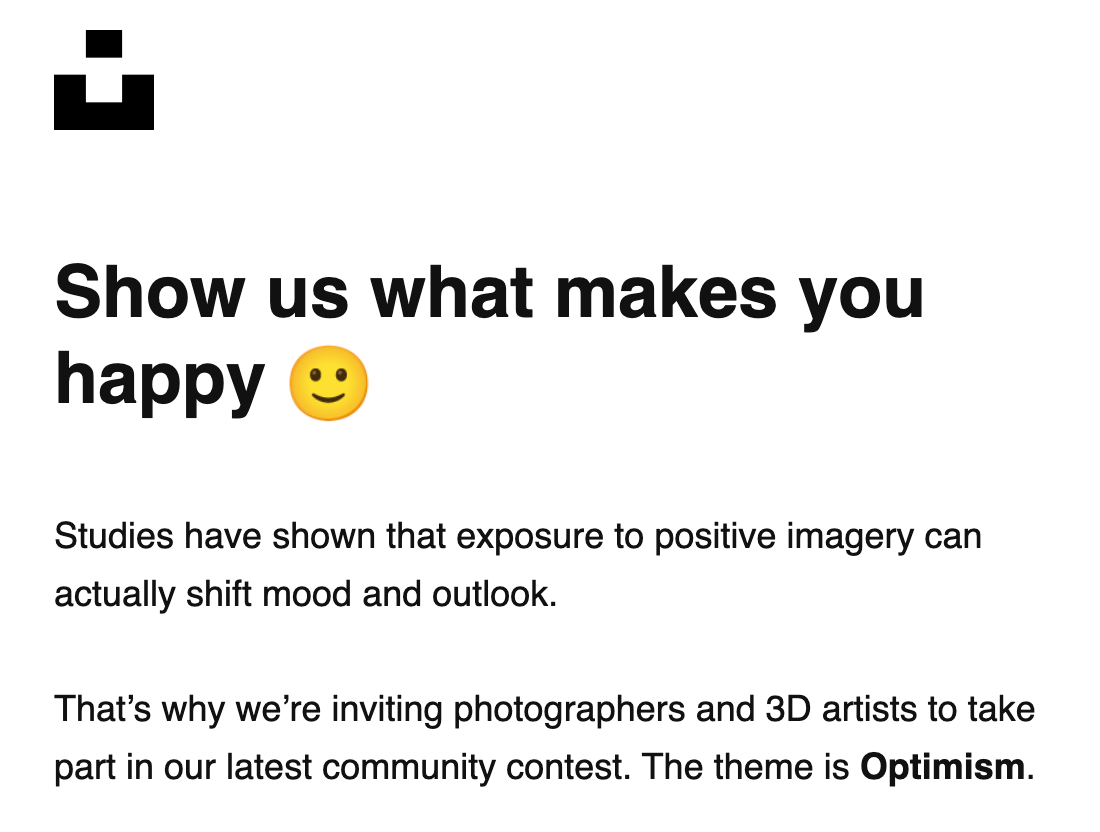
I love Unsplash, a community-driven stock photo website, both as a user and contributor. I have more than 21 million views across my 159 contributed photos.
The contest prompt? “Show us what makes you happy 🙂”
Which... isn’t about optimism at all. It’s about a momentary mood.
Why optimism is better than happiness
If you’ve been around here for even a little bit of time, you’ll recognize my definition of grounded optimism:
Choosing to find possibilities in an unknown future.
Happiness is an emotion. It’s momentary. It’s somewhat fragile.
Happiness is the weather at a particular moment in time.
Optimism is a mindset, a posture. It’s lasting. It’s mostly durable.
Optimism is the ecosystem that spans all kinds of weather over time.
Research is pretty clear: Psychologist Iris Mauss at UC Berkeley (among others) shows that people who make “being happy” their primary goal actually report lower levels of well-being and higher levels of loneliness. Happiness ends up being, to a larger degree, out of your control because it’s largely dependent on external conditions. Happiness was never meant to be the end goal. It’s a benefit of being human, not your purpose.
Research is also pretty clear about optimism: building a practice of grounded optimism is about purpose and behavior, not just mood, which in turn drives long-lasting mental and physical health benefits. A landmark study by Martin Seligman (often called the father of positive psychology) found that optimism is more directly related to your internal locus of control and, therefore, higher levels of satisfaction and well-being than happiness alone.
(To be fair to Unsplash, creating a photo catalogue of optimism might seem kind of wonky to the community: from my perspective, the collection on optimism would have photos of people struggling but not giving up, people resting and recovery, people choosing a solution that isn’t perfect but is still works out, people holding on to the belief that there are possibilities even when they don’t know how it’s going to play out. Maybe I’ll submit a few of these and see what happens 😉)
Why people keep getting optimism wrong
It’s not just Unsplash. Books, studies, and infographics get optimism wrong all the time.
One recent survey and infographic asked participants how much they agree or disagree with the following statement: “The world is going in the right direction.”
This has very little to do with optimism. If I saw a car heading toward a cliff, it wouldn’t be pessimistic to think it would be heading in a bad direction. Nor would it be optimistic for me to believe that a parked car is safe from falling off that same cliff.
Optimism is much more dynamic than a simple “I like this, or I don't like this.” That’s happiness (or sadness). Not optimism.
To make a finer point: I can believe things in the world are going the wrong direction in a particular moment, year, or decade. And at the same time, I can believe in possibilities—that humans are resourceful, resilient, and creative, able to meet the moment they are in and find a deeper purpose that allows them to learn, adapt, and grow in the midst of hardship and challenges.
Happiness isn’t a bad thing. It’s just limited in what it can do for us, especially when things are hard. Or when we are exhausted. Or when we see things going a direction we don’t want them to.
This is why grounded optimism is a mindset and posture, a practice you can develop as a skill.
Choosing to find possibilities in an unknown future.
You can make a choice. You can hold the belief that there are multiple paths forward (not just best case and worst case). You can acknowledge the difficulty and the unknown, without having to practice toxic positivity. And you can keep practicing this over and over again, building an ecosystem that endures all kinds of weather.
If you want to go deeper on optimism as a practice and skill (or to talk about your experiences with happiness versus optimism) hit reply — or better yet, schedule a free Discovery Call.
This dispatch was written to music, including the 1966 album, Pet Sounds, by The Beach Boys. The album was released 60 years ago this week.